Wednesday, May 22, 2019

Game of Thrones: In Stops and Starts

Image result for kings landing
Everything is fine.


So many people have weighed in with their thoughts on the last season of Game of Thrones that even my favorite existentialist Slavoj Zizek has a column on it. Naturally, his contribution to this genre is one of the best in it, while being one of the shallowest things he has written.

It is true that, in the series’ swift denouement, a strange logic takes over, a logic that does not violate credible psychology but rather the narrative presuppositions of a TV series. In the last season, it is simply the preparation for a battle, mourning and destruction after the battle, and of the battler itself in all its meaninglessness – much more realistic for me than the usual gothic melodramatic plots. 
Season eight stages three consecutive struggles. The first one is between humanity and its inhuman “Others” (the Night Army from the North led by the Night King); between the two main groups of humans (the evil Lannisters and the coalition against them led by Daenerys and Starks); and the inner conflict between Daenerys and the Starks. 
This is why the battles in season eight follow a logical path from an external opposition to the inner split: the defeat of the inhuman Night Army, the defeat of Lannisters and the destruction of King’s Landing; the last struggle between the Starks and Daenerys – ultimately between traditional “good” nobility (Starks) faithfully protecting their subjects from bad tyrants, and Daenerys as a new type of a strong leader, a kind of progressive bonapartist acting on behalf of the underprivileged.
...
But – let’s bite our sour apple now – what about Daenerys’ murderous outbursts? Can the ruthless killing of the thousands of ordinary people in King’s Landing really be justified as a necessary step to universal freedom? At this point, we should remember that the scenario was written by two men. 
Daenerys as the Mad Queen is strictly a male fantasy, so the critics were right when they pointed out that her descent into madness was psychologically not justified. The view of Daenerys with mad-furious expression flying on a dragon and burning houses and people expresses patriarchal ideology with its fear of a strong political woman.
He captures the stakes - and the psychoanalytic arc - well, but retreats to the same inanity every other left-wing provocateur/critic of the show has taken with regard to The Thing Dany Did: she didn't, you didn't believe what's being told by _men_ did you? Which reminds me of another Zizek quote:

“We all remember the old joke about the borrowed kettle which Freud quotes in order to render the strange logic of dreams, namely the enumeration of mutually exclusive answers to a reproach (that I returned to a friend a broken kettle):  
(1) I never borrowed a kettle from you;
(2) I returned it to you unbroken;
(3) the kettle was already broken when I got it from you.  
For Freud, such an enumeration of inconsistent arguments of course confirms per negationem what it endeavors to deny - that I returned you a broken kettle...”
The scourging of King's Landing is fast becoming a moment too Real to be approached, and so one our culture will obsess over, and over again, portraying differently each time, until it becomes an objet petit like the death of the Punisher's family or the 2016 election.

Left critics of the show therefore risk coming off like Soviet-apologists, who deny war crimes and police states as mere capitalist propaganda.

While this skepticism may sometime be useful (and dangerous!) in understanding historical accounts, it's terrible and lazy as artistic analysis. "Let's just say this bit is false and ignore it!" You could do that to anything in the work then. You're not understanding it at that point, you're just writing (negative) fan-fic. I managed to write a month log blog analyzing thirty scenes of the Star Wars Prequels with a revisionist take and still never had to resort to "this part you see didn't happen."

Sure, if something is a story within the story - particularly if it's given as exposition or just stylized - we should think more on what it sells about the teller than the events depicted. But the Burning was as real in its portrayal as everything else, and Daenerys's actions afterwards are no departure - she gives a speech in a smoking ruin and evinces no sadness or regret at the massive destruction around her.

It's still perfectly possible to do mediocre left-wing critical analysis of this turn. You can simply note that all of Game of Thrones is a fiction told by several liberal white intellectuals, who see all claimants for power as potential sinners, but the only way they can criticize a true revolutionary is by saying "well what if she went crazy and killed thousands of people for no reason?" But the war crime is no less a part of the story than Dany's womanhood itself or Cersei's many sins, so why praise one but try to ignore the other.

The solution is to actually confront the Event, and figure out from the way it was done and the context around it, how it fits into a broader interpretation of the narrative. Watch a scene and ask yourself "why did they say this? Why did this, that we might take for granted, happen?"

In particular: what are Dany's former allies all upset at her for? For killing thousands of civilians with dragonfire? Well no, in fact. She told them she was going to do this, with the fairly typical logic "my opponent is using them as a human shield, and we must stop her." Her allies could swallow this (even though this was a needless strategy: they could just wait Cersei out, who no longer had widespread support and was borrowing vast amounts of money on a ticking clock - and this was the sort of verisimilitude that the earlier books would have demonstrated.)

They were upset because she didn't stop. They had begged her to listen for surrender, and when surrender happened, she kept burning the city in the exact way she had been doing. This was the true dishonor to the protagonist/nobles.

As Tyrion said to Jon to convince him to kill Daenerys: "Does she look like a woman who's done fighting?"

We have reached the end of a decade of war, of eight years of a television phenomenon, and the good guys just want to go home. That was the source of the ennui at the Council that elected Bran; he was not a compromise candidate but an apathy candidate. And this is not at all historically unrealistic - the appetite for war diminishes as the psyche wears down, even if resources aren't also depleting.

Except Dany had just arrived. She'd been stuck in Essos for 6 seasons, and been up north for most of the time since then, and now is getting her first taste of the War of Five Kings, and she has plenty of energy to keep going. She doesn't seek a town's surrender, but it's annihilation if it threatens her. To her allies, that's just so... extra. They don't have time for that anymore, and certainly not time to "break the wheel" across the known world.

The parallel to the creative process is obvious. A show about sprawling webs of connection and inter-related reactions, where every victory led to three unexpected backlashes, and nothing was without consequence or a reason to bring on an entirely new character and perspective... was coming to an end. In some sense the narrative of this world completely rebelled against any neat ending. "But how would the Lords of the Reach react to Bronn? Wouldn't someone from Essos invade a weak and divided Westeros? Why would Jon stay North of the Wall once the Unsullied are gone?" Those are all the questions that an earlier book would ask. But in another sense, the narrative demanded an end or else it would eventually cease to be a narrative at all, just a series of chaotic events, repeating only in their meaninglessness.

Does this resonate with the culture the writer's are coming from?

The same day I saw the Zizek column I also saw this tweet explaining the Democratic primary:


Elizabeth Warren and Bernie Sanders and other Democrats are Daenerys here: they have seen the energy activated and the Democratic base by Trump, and they want to use it to continue on. They want to break the wheel of Republican intransigence and corruption, and pass a full slate of the progressive agenda (and wreak significant cultural changes too.) In the idealistic sense, they are almost certainly right.

But the actual voters are tired. They want Dany to stop. They want the biggest hit of a show ever to end somehow. They're fine with Bran as King and Biden as President, just so long as they can return their attention to something - anything - else. They'll take resigned acceptability over the unbearable tension of things continuing on, and on, with no resolution in sight.

Saturday, April 27, 2019

Avengers Endgame Pseudoliveblog


(Reactions not written as they happened, but arranged on the timeline as if they were.)

Okay this was a good start to the three hour capstone of their franchise. They kill God in the first five minutes - which is both to say the big purple guy who acted as Authority, and also any hope of using the old methods to return things to harmony. All that's left is the bleak freedom/existence of moving on in the world under your own power.

Five years later, the reemergence of Antman brings the fuel of innocence to our heroes. They've given up, but he's as angry and hopeful as they were on Day 1 of the postSnap world, and that kickstarts them into action. And the initial sheer craziness of his idea "let's invent time travel" also fits this existential theme. Let's just do whatever the fuck we want, nothing is impossible, we can fuck with the nature of the cosmos if we want to.

Unfortunately this is where the movie starts... going back on the rails, and becomes worse over time. Their solution of course is to "steal back the past." This is not just recovering those elemental stones which were destroyed, but also represented by diving back into previous movies of the franchise. The solution to our problems is retrieving the Way Things Were in Avengers 1 and Guardians to the Galaxy and Thor 2 (???)

Also a sidenote: the Infinity Stones themselves - aka the Captain Planet elemental harmony of this universe - are just criminally under-explored. Like yes we have two good scenes about the Soul Stone, but all six of them should be doing something different and interesting and powerful, that makes their combination more interesting than "you have collected 5 out of 6 Macguffins." What is wielding the Mind Stone like? How does using the Space Stone change you? What is the Reality Stone even doing? (Granted Doc Strange did discuss the Time Stone some, but let's just admit that was bad even if explored.) This would be whinily asking for a fictional universe to reveal more of its wikipedia to you except that each stone got at least a whole movie about it. They spent a movie on each stone before uniting them, and we still know barely anything about them other than "with our powers combined." Criminal.

Anyway, having begged the past to return, we also get the return of Thanos. And from there the movie goes downhill. He's not even the principled Authentic Evil of the previous movie (and the beginning of this one) who is noble to others in his insanity. No he's just an abusive asshole now, who takes grim delight in the pain of others. This Thanos does not pick his own gourds. And now we have to fight him, again. A real fight with both sides at their full power this time.

When the heroes return to the present and re-summon the dead half of humanity what we immediately see is... a Hell World. Nothing but blasted landscape and catastrophe. (This is just because of the missiles from Thanos' ship, but our perspective is so confined to this that it represents the results of their transformation.) This is the result of their hubris. (And the cavalry arriving is portrayed as portals from glowing, heavenly worlds.)

The gauntlet. They have to emphasize flabby Thor for two hours just to bypass why he couldn't use the gauntlet. He's a god, lightning incarnate, he is the obvious candidate for it (other than Vision, another sadly underused element - created to be some sort of android Messiah, and never used to fulfill that.) But this means that true power can be wielded by the Hulk - in this movie a new age New Man who has found balance between his emotional and rational halves, and so uses the gauntlet to restore Just The Way Things Were but also Not Losing Anything We've Gained Since Then.

The actual question begged of the gauntlet, of the entire franchise since Iron Man 1, is Tony Stark wielding the Infinite. This would actually confront his thirst for control in well, the way that comic books imagine these things (and he makes a much, much better villain than Thanos 2 Electric Boogaloo.)

And so we finally get a shot of Iron Man picking up the symbol of ultimate power, using it to destroy his enemies and Make Everything Right. He starts off by immediately genociding Thanos' slave army. Alright this is the corruption of power narrative I can... oh he's dying. That's just it, the end of the story. He goes out a good guy, having made the ultimate sacrifice, to kill a few thousand or million faceless aliens. Not anything actually good, but also not anything we'd care about so we can properly understand what was wrong about Stark Industries/Hydra all along.

Sidenote the second: Endgame is a chess term for the stage of a chess game where there are few remaining pieces, and so you can just brute force calculate every action, instead of having to rely on heuristics and patterns and guesses. Just two kings and two queens, etc.

I'm not one to fault the fan service superduper explosion combination of every superhero we've met over two dozen movies, but it's ironic how this overpopulation was the exact opposite of what the term means.

ADDENDUMS: Wow Karen Gillian got her payoff finally, after being very underused in her previous movies. I guess the writers just felt what the audience really wanted was lots of Nebula. It's out of nowhere, but I don't really disapprove, given that her character role is "to be the lolfail everyone kicks for not being as cool as them" (Thanos, her sister, the crew) and they just really rubbed that in, adding "her other timeline self" to the bullies that dunk on her. In some ways she is the ultimate Hufflepuff character, and I'm fine with her being the center of the capstone movie then, it's like Neville Longbottom actually becoming the main character of Book 7.

And I can think of nothing that is more MCU than taking an actually interesting scene that used music and imagery to draw people into a movie that was considered questionable - Starlord dancing by himself in the opening credits of Guardians of the Galaxy - and convinced audiences that "yeah 80's nostalgia plus alien landscapes is kinda cool and we are happy to watch even if it doesn't have Nick Fury", and returning to view that oh-so-slight-numinousness from the outside and just saying "wow he looks like an idiot." Keep being you, Marvel.

Tuesday, March 12, 2019

Get Your Captain Marvel Hottakes

From my FB chat:

Woman in Wyoming: I can’t join the Cpt Marvel reviews since I haven’t seen it yet
Me: Oh you joining the boycott?
Man in Copenhagen: Hey sometimes it’s hard to get out every month for the new Marvel movie

Which is how approaching Captain Marvel, or any other superhero / culture war movie du jour feels. So rather than give you very serious thoughtful analysis, you get two hot takes.

1. What sort of genre media gives you:
  • Protagonist is an experimental pilot and puts way too much of their thoughts and history in the context and metaphors of being a pilot.
  • Trippy memory sequences where scenes from childhood are injected with alien absurdity, and snarky manipulators of the memory giving commentary.
  • Cute, innocuous seeming animals that are dangerous monsters.
  • Wise-guy humor from aliens in exotic makeup.
  • The avatar of an unknowable alien intelligence talking to the protagonist in the image of their parental figure.
  • Alien empires conflicting in ambiguous politics but our heroes mostly think "fuck your bullshit" about the politics and prevent massacres.
  • Protagonist has the seed of immense power within them, that they only somewhat control and is growing.
  • Buddy cop comedy.
I'm saying it's basically Farscape. They might as well say Carol Danvers was shot through a wormhole as the opening credits highlight. It just has the same very surreal style as many Farscape episodes (how many episodes does Chricton wake up brainwashed thinking he is a member of an alien species?)

This is not a criticism. Farscape is great, and more of it is fun. But there's value in dropping the lens of "is this a typical Marvel movie" and wondering "what is this more like a typical example of?"

2. Gender.

Let's be honest. For all the genderwar cultural fire there has been over this movie... the main character could have been Carl Danvers, played by a dude, and like two entire lines in the movie wouldn't work. Other than those two lines (a flashback to a douchebro saying "it's called a cockpit for one reason (which would be dismissed as drunken rambling) and her best friend saying "we had to be experimental pilots because they wouldn't let women fly in combat" (which wtf that's not remotely true, experimental piloting is very risky and also male dominated -why have your sexism be completely fake)) nothing about the movie wouldn't make sense.

Sure, there's a (very undeveloped) theme of "you have to trust your emotions even when other people are saying to be logical" and "you have to believe in yourself even when other people belittle you" that will trigger anyone with highly sensitive political antennae... but honestly if you had that said about a male superhero, in a movie coming out of the 90's, no one would blink an eye. Those comments are not at all gendered unless you are expecting them to be.

And if your "breakthrough female character" can be replaced with no changes with a male, well a) that's actually good in terms of "acting egalitarianism", but b) you are not exactly rocking the world with the revolutionary political message of your movie.

Don't let cultural memes pull you into "controversies" when the substance of the fight is something as anodyne and milquetoast as this. It's an extremely gender neutral flashbang movie (that resembles most, a 90's scifi channel show.)

Don't fight over things not worth it just because "have you heard what they're saying on RottenTomatoes it's so upsetting." Watch the object in question yourself.

Tuesday, July 24, 2018

Meaningless: the Imaginarium of Doctor Parnassus

Image result for imaginarium parnassus


I finally saw this cult classic of Terry Gilliam and Heath Ledger's final half-performance. Like all my reviews, spoilers abound, so placing this below the cut.


Friday, May 4, 2018

Infinity Thoughts

So Avengers Infinity War happened. I enjoyed the experience of seeing it. But there's nothing interesting to say about it because while it has workmanlike quality, it's just too incoherent.

Image result for thanos

I'll at least explain why below the spoiler cut.


Wednesday, March 28, 2018

Pacific Rim Thread

In honor of Pacific Rim 2 coming out, I've compiled the fantastic SMG responses on the SomethingAwful thread about Pacific Rim 1. It's a great discussion of fascism and nearby ideologies, Christian symbolism, mecha anime and kaiju cinema, film techniques, and fascism's root as an artistic movement.


It's also useful for interpreting Del Toro's other work, such as his Oscar Best Picture win for "Shape of Water." As SMG points out, all of GDT's movies are about "Nazis fighting monsters."

<<<Everything from this point on is by SuperMechaGodzilla and not by me.>>>


Wednesday, February 7, 2018

Cloverfield and Bad Critiques of Capitalism

You may have heard that Netflix did a cute publicity stunt this week, by showing the very first advertisement for the big budget movie "the Cloverfield Paradox" with a Super Bowl commercial, and telling fans... that they could watch as soon as the game was over. Just surf over to Netflix and there it would be.


According to mainstream/hip/progressive media journalism, this was the oncoming of the capitalism apocalypse.

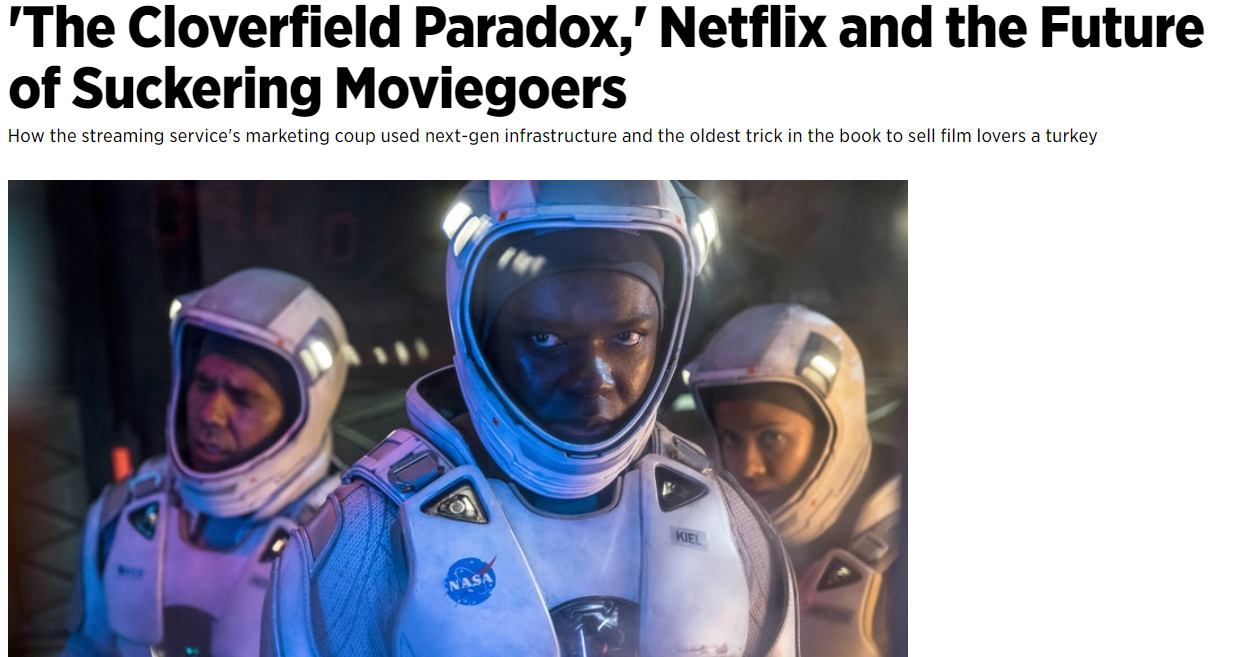
https://www.rollingstone.com/movies/news/the-cloverfield-paradox-and-the-future-of-suckering-moviegoers-w516382


People who'd been following the progress of a third movie, sometimes referred to as God Particle or simply Untitled Cloverfield Project, might have sensed something was up when Paramount kept playing release-date musical chairs with it, moving it from February 2017 to October 2017, then February 2nd, 2018 ... then April 20th, 2018. And even these eagle-eyed watchers might have breezed past The Hollywood Reporter story in mid-January that hinted at Netflix being in talks to acquire the property, rumored to be in even rougher shape than previously imagined. At which point, the service thought: We can get this for a song. How do you save an unintentional suckfest? You turn it into a surprise event. That unveiling during the Super Bowl, part callback and part cryptic little sneak peek, is the sort of marketing coup that deserves an eternal slow-clap. 
That's one way of looking at it, of course. Another way is that they've simply found a cutting-edge way to pull the oldest trick in the promotional book. When Ms. Knowles pioneered the surprise-album drop, she relied on old-school codes of omerta and a new technological infrastructure that suddenly allowed you to go from studio to iTunes in a click. If it's not the new norm, it was certainly a bold new business model, one applicable to the right combination of name recognition and supply/demand economics. Thanks to Netflix, which pays lip service to the theatrical-release model even as it seems hellbent on cutting it off at the knees, the film industry may now have its equivalent infrastructure for such moves as well. As an experiment in attracting attention, cost-benefit economics and dodging a flop-film bullet, this is a huge win. 
For people who care about the quality of movies, including big blockbuster ones, and who will never get that 102 minutes back, however, this is not being Beyoncé-ed. It's the art of being P.T. Barnum-ed. At which point we can only look straight into the camera, fix the service with our best fretting Gugu Mbatha-Raw look, and solemnly intone:
"Whatever you're doing, Netflix: Stop."

If you read the whole article, you'll get a lot of moralizing about how scammy this approach is, but extremely little commentary on what makes the movie bad. There's just widespread assumption that you WOULD use this release method for a flop, and the author doesn't know anyone who liked it, so it must be an objectively bad movie that the executives knew would be bad.

For people who care about the quality of movies... maybe you could discuss the quality of this movie. Maybe criticize the dialogue, or pacing, or CGI, or anything?

So I actually watched it. And it's... fine. It's space-horror, with a big budget, and some good actors, and an attempt to use the genre to talk about how we deal with decisions we regret. It's not as brilliant as Event Horizon or Solaris or Alien, but it is well within the same genre that brought us LIFE or Aliens.

(It also features a black woman in the lead role, which I keep being told Hollywood never does outside movies with a political bent.)

This is not me saying "all movies are good and the movies critics call bad are actually camp classics." Paradox doesn't even aspire to that level of art. It's just a perfectly middlebrow horror scifi movie with a few JJ Abrams style touches. There's nothing in here that would make a studio executive say "Wow we've got one hell of a turd here, how do we unload it?"

Not to mention the weird paranoia that Netflix is trying to pull a fast one and trick people into watching a movie they should be warned from. For most of the audience, they're already subscribers and Netflix made no money from. It probably got a few new subscribes from this, but really a subscription service is the opposite of what payment system is trying to "sneak one past" consumers.

***

The closest we get to actual criticism is resentment at the teasing of Abrams world-building.
A large shadow appears and then there's that mystifying roar. A child is found, and saved, and only kinda sorta mentioned again. Then, at the very end of all this, right before the credits, a giant monster appears, some sort of variation on the original Cloverfield kaiju. See? It really is all connected. Cinema!
Which is reflected in other reviews, that they were really hoping this movie would answer some of the questions of what is going on in the "Cloververse." Just what is that big monster?

And, no. Just no. I have zero pity for anyone seeking that.

There is an argument for enjoying world-building as it's own thing. Balioc will be better able to defend that than I, but people feel they get value from reading it, and I won't say there wasn't value there.

But that is entirely different from demanding worldbuilding as the satisfaction from a work of art or author who has no intention of giving it. From the very beginning Cloverfield was about the mystery and the unknowable. Abrams has done this in most of his high profile works. And the second movie, 10 Cloverfield Lane, did not try to make anything clearer.

What the hell were you expecting from Cloverfield 3? The monster was Rey's father?

JJ ABRAMS IS NOT GOING TO TELL YOU HOW HIS UNIVERSE WORKS.

And if he did, you would be merely disappointed.

But with an obsessive focus on this reveal, his movies are criticized not for being bad, so much as his "cheap" tactics of being unwilling to give us the answers we need. Paradox was a flop in their mind because it didn't tell us what the monster was.

Abrams is withholding his jouissance, and this Netflix stunt is a way of tricking us into watching the movie without receiving the jouissance. "Whatever you're doing, Stop."

***

Which brings us back to this sort of popular-media Jacobin style critiques of capitalism. They take this woke posture, defending consumers from the evil tricks of Corporations, but are entirely empty of actual anti-capitalist theory. It's not about looking at the relationships between workers and production, or sharing the vast wealth our world has with the poorest, but just "you are unhappy and lets blame corporations for it. I don't understand art, so it must be the fault of profit-seekers who COULD give me what I wanted, if they weren't such jerks." It's banal and terrible and not Marxism.

Trashing a movie and fretting over a publicity stunt do not make you warriors for economic justice, RollingHuffStonePost.

***

Updated with SMG's take:
To do that, you first need to reverse-engineer the film to understand why The God Particle was made in the first place. Like why, at some point, did multiple people think this was a great idea for a movie?
If you actively ignore the extremely poor storytelling and exposition, God Particle actually has a very good concept for a horror movie:
The idea is that there are two parallel universes - the peace universe and the war universe. In the war universe, the space station gets sabotaged and crashes into the ocean, where the survivors are now in a fierce battle for survival.
Because of the experiment, the two universes cross over at random points - and the people from the peace universe naturally experience these crossovers as eruptions of nightmare imagery.
The most obvious example of this is when the airlock suddenly gets flooded with a ton of water - from the ocean. Air from the peace universe is being switched with water from the bad universe, and vice-versa. The Russian guy’s eye is going weird because half of his brain has been exchanged with the brain of his war-universe counterpart.
So basically there’s this entire parallel storyline where the offscreen people of the war universe figure out what’s going on, and start sending messages to the peace universe. The disembodied arm is actually connected to the Italian on the other side - so people in the war universe are basically watching their Italian crawl around on the floor while a disembodied arm floats around the room, flipping them off. The war people use this knowledge to send things like the compass through - they obviously discovered, from the worm incident, that the Russian’s stomach is the location of one of the portals. (As for how the war universe’s Russian guy ended up swallowing a ton of worms, I guess that’s left to the imagination.)
Basically everything not directly related to this narrative was added to promote the Cloverfield franchise. And it seems obvious that a lot of stuff was cut out to make it fit.
The charitable take is that the shitty ending is a probably-unintentional reference to Watchmen.
After the opening scene badly establishes the rise of nationalistic tensions and the threat of nuclear war breaking out, the utopian end-of history conclusion is accompanied by the promise/threat of a new, inhuman terrorist enemy against which we can unite. Hence the specific image of Clover - the 9/11 Kaiju par excellence.