Sunday, November 23, 2014

The Greatest Threat to the Republic Since Voter Fraud


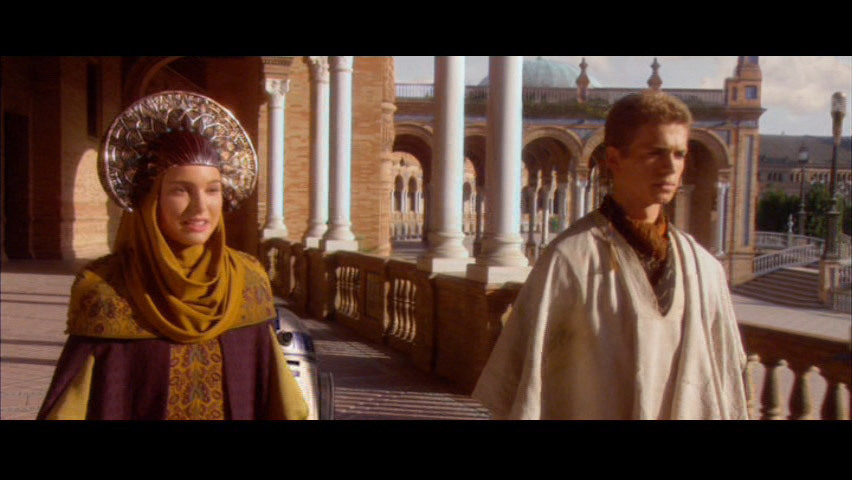
I already referenced this line, but I cannot get enough of this incredibly awkward line from Obi-Wan.
ANAKIN
She's not like the others in the Senate, Master.
OBI-WAN
It's been my experience that Senators are only focused on pleasing those who fund their campaigns... and they are more than willing to forget the niceties of democracy to get those funds.
ANAKIN
Not another lecture, Master. Not on the economics of politics.... It's too early in the morning... and besides, you're generalising. The Chancellor doesn't appear to be corrupt.
OBI-WAN
Palpatine's a politician, I've observed that he is very clever at following the passions and prejudices of the Senators.
ANAKIN
I think he is a good man.

This is just hilarious (and remember, Count Dooku plays on Obi-Wan’s fear of corruption in the interrogation scene later). We’re watching a movie about space empires and magical forces and laser swords and we get glib admonishments about campaign fundraising straight out of a New York Times editorial. It completely breaks the epic feel of the story, which is a tool we’ve seen used many times in the Prequel Trilogy.

It’s possible that Lucas personally felt that campaign fundraising really is the ultimate corruptor of democracy, a point so important he had to insert it into his space movie. Or he was purposefully using it to show the short-comings of purity-politics in modern American discourse. Either way it doesn’t really matter (and is as inaccurate about our current political problems now, as it was in a galaxy far, far away.)

It’s a point of view completely insufficient to the problems the Republic actually faces. The Senate is in very real danger, and will eventually implode and take the Republic with it, for reasons that have nothing to do with fundraising. It’s because a Sith lord is running things! GUYS!!!

(The exchange about Palpatine is equally ironic. Anakin is wrong about Palpatine being “good”, but the defense that he is a “good man” is very interesting when talking about the relevance of internality. However well Anakin might feel he knows Palpatine, it’s his actions that matter. More adroitly, Anakin notes that the Chancellor doesn’t appear corrupt. And he’s 100% correct - the problem with Palpatine is not corruption.)

The Jedi have a problem. They want to transcend this dirty world. Yoda says of humanity in Empire Strikes Back “Luminous beings are we, not this crude matter.” (Once again an emphasis on internal truth, over real world actions.) But they are very attached to, and dependent on the Republic.

So they disdain it.

They condemn the Republic for being impure, and give little consideration to how to fix things or make it better (ignoring the suffering of Tatooine as they pass through). They use it to fund their Council, and their independence, and their accumulation of power. And over a thousand years of this… they’re no closer to ascending to this pure state than they were at the beginning. The Jedi need to start their project from scratch, and this time take everyone with them.

It’s not like Obi-Wan’s writing didn’t have a choice. There are any number of good, or just in character, warnings he could have given Anakin. “Stay away from her because you have attachment issues, Anakin.” “We’re assigned to protect her and emotional involvement could compromise that.” “Jedi don’t get involved romantically.” “Being too close to the leader of the opposition could make the Jedi look partisan.” “She doesn’t even notice you, kid.” Etc.

No, Obi-Wan chooses some concern that has zero relevance to the plot, in order to illustrate how blind he is to the problems of the world. Masters never are right in arguments with apprentices.

***

This scene becomes even funnier when we look at the climactic duel of the whole trilogy.
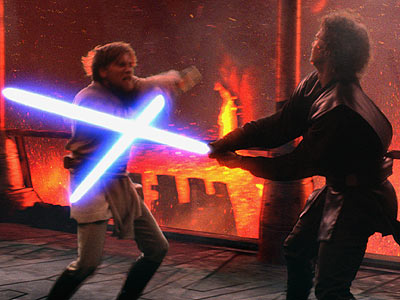


ANAKIN
Don't lecture me, Obi-Wan. I see through the lies of the Jedi. I do not fear the dark side as you do. I have brought peace, justice, freedom, and security to my new Empire.

OBI-WAN
Your new Empire?

ANAKIN
Don't make me kill you.

OBI-WAN
Anakin, my allegiance is to the Republic ... to democracy.

ANAKIN
If you're not with me, you're my enemy.

OBI-WAN
Only a Sith Lord deals in absolutes. I will do what I must.

Obi-Wan’s highest worldly ideal is to “democracy”, even as he dismissed its instruments as pettily corrupt. He says “only a Sith Lord deals in absolutes”, but at least they have goals, aims for society. The Jedi can’t envision anything they want government to do, and so stand only for protecting its machinery. And as that Republic falls short of their transcendence, they blame it not on bad goals but on lack of purity. They don’t stand for “absolute good” or “absolute love”. Just generic plurality of opinion.

It’s not much respect for that either. Palpatine, according to Obi-Wan, “is very clever at following the passions and prejudices of the Senators”. Uh, what exactly does he want from a democracy if not that? Sure, you can have a more subtle understanding of democracy than simply popular will… but at least some respect for the popular will is the whole point of the process. Obi-Wan’s got nothing, just cynicism and smug superiority that devolves into mindless defense of the status quo when his feet are to the fire.

Saturday, November 22, 2014

Fight Scenes: Light Sabers

What is the Force?

Isn’t it weird how these sorcerers of arcane powers settle their disputes usually with fencing? Sure it’s fun to watch, but isn’t it weird.

We already discussed how the telekinetic powers introduced in The Empire Strikes Back are more of a genetic aberration than the true power of the Force. The Force everyone can tap into is a trust in the guidance of the universe, following the path meant for you. (Han Solo, for instance, can not lift rocks with the power of his mind, but he can wield a light saber, and he can fire a pistol while his eyes are blinded, yell “trust me!”, and hit every shot he needs to.)

Why are Jedi so focused on laser fencing then?

There are many ways you could do combat that are about manipulating the world around you. (And we often see Dark Side users try to interfere with a duel by Force-throwing objects, or shooting their lightning beams.) But a light saber duel is about letting yourself be guided.

The first introduction we get to “how to use a light saber” really is “Luke wearing a blind helmet while a bot shoots at him, and he has to deflect it.” Jedi don’t stop a blaster shot by creating some shield that deflects it. They subconsciously let their body and sword go to the position where it deflects the shot. They basically ask destiny “where should my sword be”, and then put their sword there, trusting in destiny to keep them safe.

Someone who has superior “Force” has a deeper connection with destiny, and is more willing to trust its suggestions, and so becomes a better duelist. The Jedi with more Force, wins.

Every light saber fight that comes to mind right now is won by the Force user who is more willing to trust the universe. Against the Luke of Return of the Jedi, Darth Vader never stood a chance.

Friday, November 21, 2014

Fight Scenes: Armies

A couple more points on the fights at the end of the Episode 2, which we discussed somewhat yesterday. Star Wars has fights that can roughly be broken down into three categories: fighter focused spaceship battles, light saber duels, and armies versus armies.

Like Episode 1, it can’t escape our notice that once again, Episode 2 ends with two armies clashing where neither side is composed of normal humans. We saw droids and gungans fight it out (and die) for their human masters before, and now we see droids and clones fight it out. Lucas has a pretty good handle here on imperial dynamics, and who dies for who.

We can contrast this with the Original Trilogy, where the major army conflicts (Hoth in Episode 5 and the Sanctuary moon in Episode 6) involve (on the rebel’s side) humans and aliens working together, but most definitely many humans giving their life for the cause alongside their alien brothers and sisters.

(The Ewok-Rebel-Droid interactions are so layered and complicated that I doubt this blog will be able to get to them and explain them fully. You could ask me directly if you wanted an analysis of their ambiguity. But suffice to say, at least their complexity is superior to the Gungan lambs that have been sent to the slaughter in Episode 1.)

***

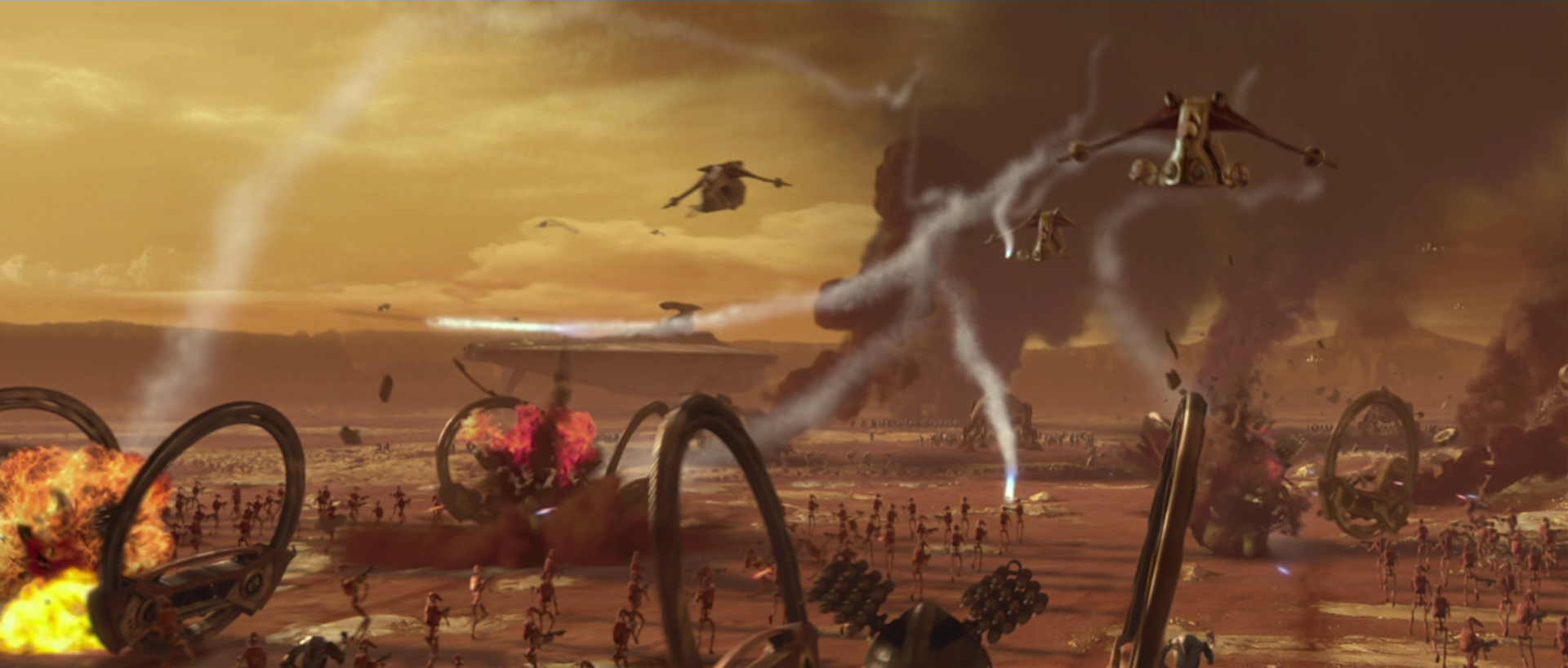
I'm particularly struck by the armies at the end of Attack of the Clones.


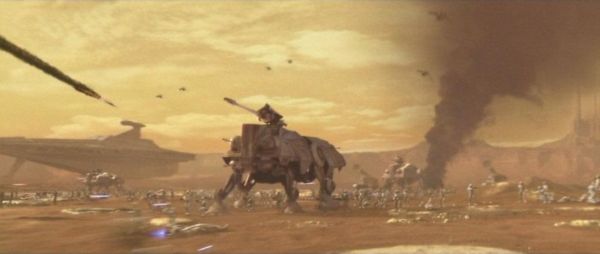
The artillery and ships that the Clone Army come with are suddenly reminiscent of designs we've seen before: the Star Destroyers and AT-AT's of the original trilogy. Between them and the clone trooper outfits, we're gradually blending in the design cues we know of the Empire.


But I particularly like the contrast here. The droid artillery rides inside giant wheels, that recall the destroyer droids at the beginning of Phantom Menace. The mechanical people use wheels and continuous movement.

Whereas the Republic forces use craft with articulated joints that move like organic creatures. 

The look and elements of these tools are very thought out. They are meant to evoke certain feelings from us. Which is why I give them so much credit when they make us feel uncomfortable, or that something is wrong.

For one last piece of evidence, what does this artillery cannon make you think of?


Thursday, November 20, 2014

Head of the Jedi Council, A Character Explore

So let’s talk about the protagonist of second prequel, Jedi Master Yoda.

Yoda still isn’t the focal character, but he is the one who shows the deepest arc. We see a lot of Anakin and Obi-Wan, but how are they different at the end of the film from the beginning? They stay who they are, but it is Yoda who changes.

Yoda starts the movie sad. He realizes the Dark Side has been outmaneuvering and clouding his vision, as he admits privately (but not publicly of course; he couldn’t shake faith in the Jedi institution.) He teaches the younglings --

-- a moment for the younglings here. Younglings is a great word, like midichlorians. It sounds silly and completely against the numinous feel we associate with the Jedi of the Original Trilogy. Yet if you try to break down what’s behind something sublime and underexplained, that is often what you get. “What was Yoda doing before the Clone Wars, we wonder?” “He was training the younglings.” “Oh. That sounds boring.” “You asked.” --

-- and looks bored. His friend and protege Obi-Wan comes to him with a really obvious question and is generally being a patsy, Anakin (the figure of prophecy) is whiny and ignoring his teachings, the galactic polity is falling apart and he doesn’t know what to do.

This climaxes right after Anakin slaughters the sand people who took his mother, and we see Yoda sitting alone in his sad little meditation room, looking helpless and lost. The scene works on the level of him reacting to Anakin’s turn, but also on the broader level of feeling like you’re losing without an enemy to fight.


We can all sympathize with this. Life is hard and often out of control. We see so much that is wrong going on in the world, but we have no idea what we can do. Bad things happen to good people, and we don't know why. It is a despair anyone can fall into, but especially a directionless liberal democracy.

And then Yoda is given an enemy. And the power to fight it.

He takes the Clone Army that Obi-Wan discovered, flies off to Geonosis to fight the Droid Army and rescue his friends who are in danger.

How does it feel? The look on his face is… pure awesome. Now he’s in the field, giving orders and being taken seriously. He’s commanding lasers that blow stuff up, flying in on gun ships. In the most crude display of power he whips out his light saber and goes to town on Darth Tyrannus. The whole sequence is really fun, and audiences (including myself) cheered for the joy of it.


(If Yoda suffers from epistemic impotence at the beginning of the film, then at the end… one can’t really ignore that the light saber is the most blatant scifi phallic symbol since “rockets”.)

Problem is, the whole thing is a bad idea, right?

Remember that the audience doesn’t know anything that the Jedi don’t know during the course of the film (besides the long term doom), but we can tell it’s a trap. It is patently clear that the Sith have been manipulating the creation of the Separatist movement and that the Clone Army was created under very suspicious circumstances. Everything about the situation glows “danger”.

Yoda has just picked up and encased himself with the weapon that the “good guys” at the beginning of the film were worried about using. But hey, it was an emergency. And the attack of the clones is a serious threat. But just because it was a serious threat doesn’t mean that the Clone Army isn’t a weapon secretly programmed to kill them when they least expect it, as we find out in Episode 3.

The best line that gives this all away is what Yoda says at the end of the movie about the events that have just transpired.

YODA
The shroud of the Dark Side has fallen. Begun these Clone Wars have.

Is there a more wrong statement in the entire sextology? The shroud of the Dark Side is very firmly in place and the Jedi have absolutely no idea what’s going on. But he’s made the mistake that because he found an enemy, that they have The Enemy. Darth Sidious is successful because he doesn’t try to trick the Jedi (and his apprentices) into fighting people they really have no differences with (as we see in most movies about false conflict), but he tricks them into fighting their legitimate opponents on his terms.

None of the problems that Yoda is worried about at the beginning of the film (clouded vision, Anakin’s attachment issues) have been resolved. At this point they’ve been forgotten even. This is not a coincidence or "bad writing" suddenly forgetting various plot points it raised before. Rather it's a way of illustrating how the allure of power and clear cut enemies distract us from our real problems.

***

I said that Jar Jar Binks is the protagonist of Episode 1, and that doesn’t just mean change over the film but that the story of the film is his story. Jar Jar’s story is about the induction of colonized cultures into the Republic. So what then is Yoda’s?

Episode 2 is the story of how a peaceful liberal democracy can be tricked into becoming a fascist dictatorship. It’s also the story of how a quasi-buddhist monk can become a militarist who leads his people into a fatal war.

(Episode 3’s protagonist, the person who changes over the course of the story and who’s story mirrors the world, is... Anakin Skywalker, of course.)

As fans we let a collective groan loose when we think about the Clone Army. How could they be so dumb as to take this army that they know what ordered under false name? And I’m sure Yoda thinks about that too. What does he say to it?

We get a parallel question answered when Chancellor Palpatine accepts his emergency powers.

PALPATINE  
It is with great reluctance that  I have agreed to this calling. I  love democracy... I love the  Republic. The fact that this crisis is demanding I be given absolute power to tule over you is evident. But I am mild by nature and have no desire to destroy the democratic process. The power you  give me I will lay down when this crisis has abated, I promise you.

And that’s not a lie, from the galaxy’s greatest politician. The crisis never ends. You never have a world without conflict.

Yoda must be thinking the same thing as those Senators. Sure, he’ll investigate the Clone Army more closely when the crisis ends. But right now there’s fighting to be done, Jedi to save, and no time to worry about procedural niceties like “where did this superweapon come from?”

Except you were wrong Yoda. And now everybody’s dead.

Wednesday, November 19, 2014

Before the Deluge

So what’s the plot of Episode 2? Roughly, the peaceful Republic doesn’t have an army. They are debating whether to form an army to deal with separatists, which some liberals (Senator Amidala) feel will give up their ideals. Amidala is chased off Coruscant by a series of assassination attempts, Obi-Wan follows bread crumbs to a secret clone army, and then to the staging ground of the separatists. In the final act, the Senate votes emergency powers to the Chancellor and uses the army to fight the separatists.

These are the short term causes of the revolution, where the liberalism of the Republic finds itself giving way to the fascism of the Empire.

Amidala is the strongest politician opposing this militarization at the beginning of the movie, so really what the Sith need to do is remove her from play.

That is all that is going on at the beginning of the movie. There’s this complicated mystery of who wants to kill her, when it’s as simple as “get her out of town for a vote.” I’d say it’s lamentable that she falls for it, but she doesn’t even put up a fight. Palpatine asks her to leave “for her safety” and she agrees (it’s off-screen so we don’t know if her compliance was meek or eager, but there’s no indication she’s upset about it.) No one can force her to run away, she does so of her own choice.

The most absurd scene of the movie isn’t the oft quoted Sand scene, or the gamified fight scenes at the end, it’s this short dialogue:


PADMÉ
And, truthfully, I was relieved when my two terms were up... but when the Queen asked me to serve as Senator, I couldn't refuse her.

ANAKIN
I agree! I think the Republic needs you... I'm glad you chose to serve. I feel things are going to happen in our generation that will change the galaxy in profound ways.

PADMÉ
I think so too.

She says this as she is moving her luggage and settling into Naboo, away from the Senate. It’s mind-boggling. They’re very proud of their sacrifices!
Meanwhile back on Coruscant, Jar Jar is appointed in her stead, and flattered by Palpatine into proposing that he be given emergency powers. Lesson: the heroes are not very good at what they do, or even caring about what they profess to care about.

***

Personally, I suspect Jar Jar’s arc was always supposed to be more pronounced in the last two movies. Intention is not determinative here, but we can still guess at it. I suspect Lucas always envisioned Jar Jar putting the Emperor in power like this, because to him Jar Jar was key to the arc of the movies. I further suspect that Anakin would have killed Jar Jar in Episode 3 originally, as a symbol of the powerful protagonist (from Episode 1) killing off the innocent protagonist. Instead Binks is one of the few loose threads that we don’t know what happened to between 3 and 4, probably due to very intense negative fan reaction.

(It’s amazing how a character so overwhelmingly unpopular, can be criticized as crudely playing to some baser audience. It’s always someone else who’s being pandered to.)

To make up for it, Lucas gave the fans the finale of Episode 2, with Yoda going crazy wild in vulgar displays of power. Which is it’s own message, that we’ll explore tomorrow.

Tuesday, November 18, 2014

Second Time, Same As the First

The more I watch these, I think Attack of the Clones might be my favorite of the Prequels. It’s got so much going on. Let’s look at the beginning for a second.

Once again, we have an early scene with two Jedi discussing their mission.


PADMÉ
I don't need more security, I need answers. I want to know who is trying to kill me.

OBI-WAN
(frowning)
We're here to protect you Senator, not to start an investigation.

ANAKIN
We will find out who is trying to kill you Padmé, I promise you.

OBI-WAN
We are not going to exceed our mandate, my young Padawan learner.

Paralleling the scene near the beginning of Episode I. Before Qui-Gon was the mentor and Obi-Wan the apprentice, now Obi-Wan is the master.

Before Qui-Gon was assured and calming Obi-Wan, now Anakin is hot-headed but managed by coolly insistent Obi-Wan. Anakin is whiny and tempermental.

Except, Qui-Gon was wrong. Remember he was assuring Obi-Wan that nothing wrong was going on, right before there was a trap.

What are Anakin and Obi-Wan actually arguing about here? Whether they are going to investigate the assassination attempts. Of course they are going to investigate! We the audience wants the plot to move forward, and purely playing defense isn’t going to do anything about that. (Obi-Wan is correct in his interpretation of the Jedi Council’s orders of course, but the Jedi Council is also often wrong. Yoda just said the Dark Side is clouding their vision, but they do nothing to investigate it.)

But since these movies have the perspective of the complacent Jedi (such as Obi-Wan, or even more, Yoda who is arguably the protagonist of Episode 2), we see things as they do. Obi-Wan is calm and acting on authority, so he must be right. Anakin is uncertain and full of attachment to Senator Amidala, so he must be wrong. Even though if the sides were presented without these tints, then, we would see pretty quickly the the apprentice is right once again.

Hell, in the entirety of these trilogies, do an apprentice and master ever disagree and the master is proved unambiguously right? I’m struggling to think of any examples.

***

The scene also shows us Anakin’s unhealthy attachment to Padme, a woman he hasn’t seen in ten years (what other woman has Anakin not seen in ten years.) It’s pretty clearly a bad relationship from start to finish, but the question of attachment is a much more difficult one.

The Jedi talk about attachment, and escaping it, a great deal so we can’t really ignore it. Yet the reality the movies present of attachment is much more muddled. Luke rejects Yoda twice, first by rescuing his friends, and secondly by trusting his father. Personal attachment like that saves the galaxy.

But it looks quite bad on the elder Skywalker.

Monday, November 17, 2014

The Most Insidious Evil

Who is Darth Sidious?

He is the revenge of the Sith.

***

Earlier I mentioned characters who get a lot of description, and characters who purposefully get very little. It is amazing how little attention as a person Chancellor/Emperor Palpatine gets. His agenda dominates all six movies, after all, yet he doesn't even appear in one movie (Episode 4) and is unnamed in another (Episode 5). And for those four movies he does act in... what do we know of him?

We don't know where he came from, how or why or when he became a Sith, or anyone he cares about or knows outside his schemes. Most of his dialogue is as Chancellor, dripping with lies and condescension to the "good guys". Anyone else who had his screen time, we would know a heck of a lot more about. Three movies were made to tell us the backstory of Darth Vader, but we still know almost nothing about his master.

Palpatine is one of the most depersonalized characters in the entire series, which is interesting for someone who is the primary villain.

Which ties into the greatest concern about the Original Trilogy that I mentioned before. Is Star Wars describing a universe were "killing the one bad guy" solves everyone's problem? Or does defeating that one bad guy, actually stand for a far more comprehensive process?

So if he is more symbol than person, what does he stand for?

***

One of the few genuine things we know about Sidious is that he loves conflict. His plans always involve a ridiculous amount of "getting two sides to fight it out, while he maneuvers in the background", from Endor's moon to the Separatist war. He exhibits this especially on a personal level, taking an almost sexual satisfaction when he watches two potential apprentices fight each other for him (at the beginning of Episode 3, and the end of Episode 6).

One reading of these scenes are that he knows who will win each war or duel and has orchestrated their success, but I find it much more plausible that he set up a "No matter who loses, I win" methodology.

The scene where Anakin kills Count Dooku is one of the best scenes in the entire six movies.


It contains the endlessly repeated trope of a dismembered hand. We see Sidious's mask fall, as he hideously orders Anakin to kill. The look of betrayal on Dooku's face speaks volumes, which we will discuss later. Anakin uses *two* light sabers - his and Dooku's - to deliver the deathblow, symbolizing how Sidious always controls both sides of a fight. And of course, killing this enemy does nothing to solve anyone's problem. All of this is portrayed within a fairly swashbuckling laser sword fight.

Darth Sidious is conflict.

***

Conflict is inherent in the system.

From the very beginning of the series, conflict is there, and Palpatine is here, savoring and orchestrating these pointless battles. He is a sort of lawful chaos, insisting there will be competition and determining how it goes. (Whereas the heroes in the Original Trilogy are a sort of chaotic lawfulness, showing infinite trust in each other despite no one making them do so.)


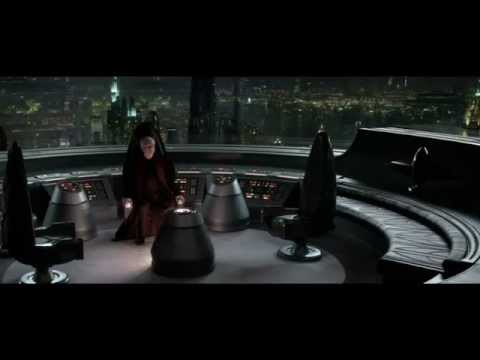
Another one of Palpatines rare lines of honesty is when confronted by Mace Windu and his squad of Jedi.


MACEThe Senate will decide your fate.
PALPATINE(burst of anger) I am the Senate!

And at this point, who's to say he is wrong?

Not that Palpatine has respect for the Senate. He takes a maniacal glee in throwing pieces of the Senate around as Yoda during their duel, creating a pretty blatant image for the fall of democracy. But then, he's always cast off his tools to replace them with something even more powerful.

There are many names for what Sidious represents. Hatred. War. Capitalism. Evil. Distrust. Class and status. He is vengeance incarnate. This is the Dark Side of the Force and he is one with it. He is it.

(The Jedi would throw in "Anger". This is wrong. The Jedi focus on emotion and attachment as someone's undoing is repeatedly shown as incorrect. Luke is correct to ignore Yoda's advice to be indifferent. Darth Sidious is just as happy to use cool necessity as the reason to abandon someone to death as the Jedi are.)

To defeat Darth Sidious then, you can not merely strike him down (as he taunts Luke to do at the end of Episode 6.) It takes a genuine act of cooperation and trust to overcome conflict. A radical act of love.

A son giving up everything for the father he never knew, and his father giving up everything for this son. That is the trust Sidious cannot predict, and is conflict's only undoing.

***

One of the greatest complaints of the Prequels is that they make Darth Vader "uncool". Vader was one of the greatest badasses of cinema, voiced by James Earl Jones, and fans were looking forward to him as a Jedi. This was the man Luke had faith in after all, that could overcome his Dark Side programming when it mattered.

But Lucas didn't need to make Anakin Skywalker "cool". He already was one of the most celebrated figures in pop culture, let alone genre fiction. Making him a cool Jedi who succumbs to the Dark Side in one moment of weakness, would only glorify his whole fascist schtick.

Instead Anakin is a punk. He is whiny, badly-tempered, and incredibly insecure. He's right about most of the things he disagrees with the Jedi about, but gosh does he come across as an unworthy jerk.

In this light, now the trust shown at the end of Return of the Jedi makes no sense. Luke is desperate to believe that his father is still inside that suit somewhere, the "Jedi" he used to be? Now we know that man never existed, there never was some supercool Jedi who was the "true" father of Luke Skywalker. Hell he was barely a Jedi. There was just a whiny proto-fascist. If Luke had seen the Prequel movies, could he have put his life in the hands of Darth Vader? Could you?

No.

But trust does not make sense.

Demanding to see the "cool" Anakin Skywalker is demanding proof of the goodness of the people you love. It is demanding his midichlorian count before you believe he is the figure of prophecy.

Radical faith is believing in the father you need even though he never existed in the first place. Darth Vader knows he was a horrible human being, but at the end he believes he can be something greater, when his son refuses to kill him.

That is the Light Side of the Force.